Swayambhunath Stupa, Kathmandu
Swayambhunath Stupa, Kathmandu, Nepal
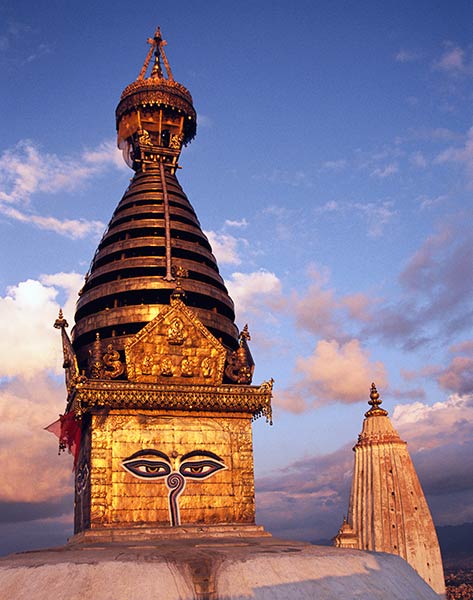 A golden spire crowning a conical wooded hill, Swayambhunath Stupa is
the most ancient and enigmatic of all the holy shrines in Kathmandu
valley. Its lofty white dome and glittering golden spire are visible for
many miles and from all sides of the valley. Historical records found
on a stone inscription give evidence that the stupa was already an
important Buddhist pilgrimage destination by the 5th century AD. Its
origins however, date to a much earlier time, long before the arrival of
Buddhism into the valley. A collection of legends about the site, the
15th century Swayambhu Purana, tells of a miraculous lotus, planted by a
past Buddha, which blossomed from the lake that once covered Kathmandu
valley. The lotus mysteriously radiated a brilliant light, and the name
of the place came to be Swayambhu, meaning 'Self-Created or
Self-Existent'. Saints, sages and divinities traveled to the lake to
venerate this miraculous light for its power in granting enlightenment.
During this time, the Bodhisatva Manjushri was meditating at the sacred
mountain of Wu Tai Shan and had a vision of the dazzling Swayambhu
light. Manjushri flew across the mountains of China and Tibet upon his
blue lion to worship the lotus. Deeply impressed by the power of the
radiant light, Manjushri felt that if the water were drained out of the
lake Swayambhu would become more easily accessible to human pilgrims.
With a great sword Manjushri cut a gorge in the mountains surrounding
the lake. The water, draining away, left the valley of present day
Kathmandu. The lotus was then transformed into a hill and the light
became the Swayabhunath Stupa.
A golden spire crowning a conical wooded hill, Swayambhunath Stupa is
the most ancient and enigmatic of all the holy shrines in Kathmandu
valley. Its lofty white dome and glittering golden spire are visible for
many miles and from all sides of the valley. Historical records found
on a stone inscription give evidence that the stupa was already an
important Buddhist pilgrimage destination by the 5th century AD. Its
origins however, date to a much earlier time, long before the arrival of
Buddhism into the valley. A collection of legends about the site, the
15th century Swayambhu Purana, tells of a miraculous lotus, planted by a
past Buddha, which blossomed from the lake that once covered Kathmandu
valley. The lotus mysteriously radiated a brilliant light, and the name
of the place came to be Swayambhu, meaning 'Self-Created or
Self-Existent'. Saints, sages and divinities traveled to the lake to
venerate this miraculous light for its power in granting enlightenment.
During this time, the Bodhisatva Manjushri was meditating at the sacred
mountain of Wu Tai Shan and had a vision of the dazzling Swayambhu
light. Manjushri flew across the mountains of China and Tibet upon his
blue lion to worship the lotus. Deeply impressed by the power of the
radiant light, Manjushri felt that if the water were drained out of the
lake Swayambhu would become more easily accessible to human pilgrims.
With a great sword Manjushri cut a gorge in the mountains surrounding
the lake. The water, draining away, left the valley of present day
Kathmandu. The lotus was then transformed into a hill and the light
became the Swayabhunath Stupa.
Stairway to Swayambhunath Stupa, Kathmandu, Nepal. Notice the monkeys sitting on Buddha's head
Swayambhunath's worshippers include Hindus, Vajrayana Buddhists of
northern Nepal and Tibet, and the Newari Buddhists of central and
southern Nepal. Each morning before dawn, hundreds of pilgrims will
ascend the 365 steps that lead up the hill, file past the gilded Vajra
(Tibetan: Dorje) and two lions guarding the entrance, and begin a series
of clockwise circumambulations of the stupa (Newari Buddhists circle in
the opposite, counterclockwise direction). On each of the four sides of
the main stupa there are a pair of big eyes. These eyes are symbolic of
God's all-seeing perspective. There is no nose between the eyes but
rather a representation of the number one in the Nepali alphabet,
signifying that the single way to enlightenment is through the Buddhist
path. Above each pair of eyes is another eye, the third eye, signifying
the wisdom of looking within. No ears are shown because it is said the
Buddha is not interested in hearing prayers in praise of him.
Dorje at Swayambhunath Stupa, Kathmandu, Nepal
The area surrounding the stupa is filled with chaityas, temples,
painted images of deities and numerous other religious objects. There
are many small shrines with statues of Tantric and shamanistic deities,
prayer wheels for the Tibetan Buddhists, Shiva lingams (now disguised as
Buddhist chaityas and decorated with the faces of the the Dhyani
Buddhas), and a popular Hindu temple dedicated to Harati, the Goddess of
smallpox and other epidemics.The presence of the Harati Devi temple
signifies the intermingling of the pantheons of Hinduism and Buddhism in
the development of the religious trends of Nepal. As Buddhists had no
deity in their own pantheon to protect against the dreaded smallpox,
they adopted the Hindu deity for assistance.
Shantipur Shrine at Swayambhunath Stupa
Atop Swayambhunath hill is another fascinating, though smaller and
less visited temple. This is Shantipur, the 'Place of Peace', inside of
which, in a secret, always locked, underground chamber lives the 8th
century Tantric master Shantikar Acharya. Practising meditation
techniques which have preserved his life for uncounted centuries, he is a
great esoteric magician who has complete power over the weather. When
the valley of Kathmandu is threatened by drought, the King of Nepal must
enter the underground chamber to get a secret mandala from Shantikar.
Soon after the mandala is brought outside and shown to the sky, rain
begins to fall. Frescoes painted on the inside temple walls depict when
last this occurred in 1658. The small temple has a powerful atmosphere;
it is mysterious, stern and slightly ominous.
Inner Door, Shantipur Shrine at Swayambhunath Stupa
Swayambhunath stupa is also called the `Monkey Temple' because of the
many hundreds of monkeys who scamper about the temple at night after
the pilgrims and priests have departed. Nearby the Swayambhunath hill
are other important temples such as the Shiva Jyotir Linga temple of
Pashupatinath, Boudhanath stupa, Changu Narayan, Dakshinkali, and
Budhanilkantha. Readers interested in studying the sacred sites of the
Kathmandu valley in detail are referred to the works of Bubriski,
Majupuria and Moran listed in the bibliography.

No comments:
Post a Comment